Quality Checks To Consider When Purchasing Aluminium Coil
From commercial to construction to electronics, Aluminium coil in UAE is an integral equipment across a wide range of industries that leverage its resistive and lightweight properties. Furthermore, Aluminium coils are metal products produced through various processes, such as rolling and tension balancing, and casting, followed by fly shear. Likewise, they are broadly used in packaging, machinery, electronics, construction, and other fields.
Nevertheless, there are high standards that every individual expects when purchasing aluminium coil UAE. These quality checks and inspections are essential to ensure they meet the high standards. Moreover, if you fail to perform the quality check, you may have to deal with the consequences later. However, in this complete guide, we will go through an imperative checklist of inspection needs for an Aluminium coil in UAE, so that whether you are an importer, professional manufacturer, or quality manager, you can easily know whether the quality of the coils is up to standard.
What is an Aluminium Coil?
An Aluminium coil in UAE is a long, continuous sheet or strip of Aluminium rolled into an extensive spool, used as a versatile raw material in different industries due to its lightweight properties, corrosion resistance, and excellent conductivity. Moreover, it is manufactured from cold- or hot-rolled Aluminium sheets. Thus, it comes in different thicknesses, often layered for particular uses, serving as a foundational raw material for roofing, electronics, HVAC systems, packaging, and automotive parts.
Pros
- It consists of Corrosion Resistance Properties
- It is Lightweight yet strong enough
- It offers excellent thermal connectivity
- It is inexpensive
- It offers low maintenance and durable properties
Cons
- Lower Mechanical Strength
- Welding Difficulties
- Difficult Field Repair
- Vulnerability to Specific Corrosion Types
- Lower Conductivity per Volume
Technical Configuration of Aluminium Coil
| Parameter | Specification Range / Typical Values | Standard |
|---|---|---|
| Alloy Grades (Typical) | 1xxx, 3xxx, 5xxx, 8xxx series alloys | Common grades: 1100, 3003, 3105, 5005, 5052, 5083, 5754, etc. |
| Standards | ASTM B209 / ASME SB209 (common) | Internationally accepted standard for Aluminium coils |
| Thickness Range | 0.1 mm – 6.0 mm (sometimes 0.2 – 8 mm with custom) | |
| Width Range | 20 mm – 2000 mm (typical), up to ~1220–1500 mm exports | Depends on mill & application |
| Coil Inner Diameter | 150 mm / 300 mm / 405 mm / 508 mm (standard cores) | |
| Coil Outer Diameter | Up to ~1800–2000 mm max | Typical supplier limit |
| Coil Weight | 1000 kg – 3000+ kg (custom) | Depends on width & thickness |
| Temper / Hardness | O (annealed), H12, H14, H16, H18, H22, H24, H32, H46, H48 | Governs strength & workability |
| Surface Finish | Mill finish, Bright, Hairline, Polished, Brush, Embossed | Finish based on market needs |
| Coating/Surface Treatment | Polyester (PE), PVDF, PVC, Fluorocarbon, Epoxy coatings | For pre-painted/almost finished products |
| Edge Type | Slit Edge / Mill Edge | Standard coil edge |
| Density | ~2.70 g/cm³ | Typical Aluminium density |
| Electrical Conductivity | ~61% IACS (varies by alloy) | Aluminium conductivity reference |
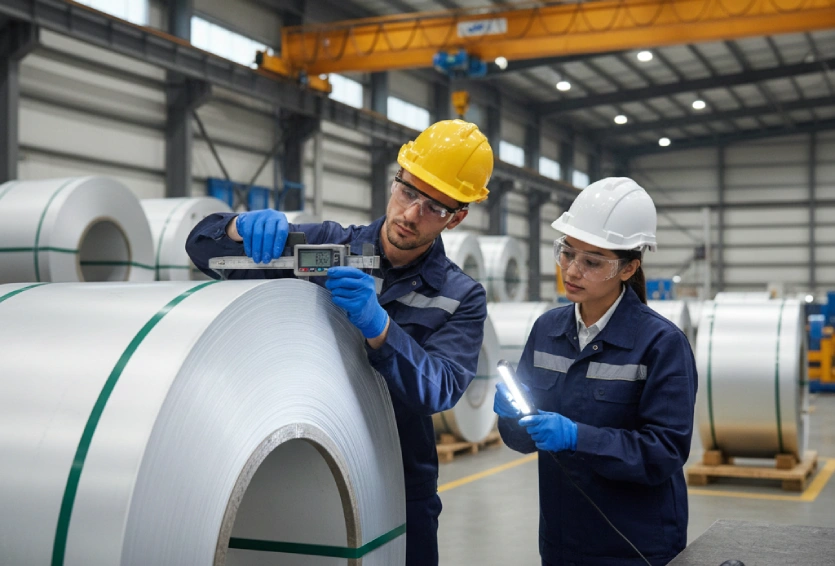
How Do You Check the Quality of an Aluminium Coil?
An effective quality control system is a well-structured quality checklist. Furthermore, we have outlined some key points you must know before investing in an aluminium coil in UAE for your project.
1. Wrought Aluminium Grades
Aluminium comes in different grades, each with its own unique qualities that directly affect the overall quality of the aluminium coil UAE. Wrought Aluminium grades are considered the most imperative because of their superior structural strength and integrity. Furthermore, these grades are defined from Series 1000 to Series 8000, and each series has a different chemical composition. Consequently, their performance varies with the environment.
For example, the 1000 series is almost pure Aluminium, making it suitable for electrical and chemical applications. The 3000 series, which contains manganese, is known for its corrosion resistance and workability. The 3003 grade is used in roofing sheets, cookware, and heat exchangers because it is strong and flexible. Therefore, knowing the wrought Aluminium grade is crucial when choosing an Aluminium coil in UAE.
2. Cast Aluminium Alloys
The most significant difference between cast Aluminium alloys and wrought Aluminium is their manufacturing process. Cast Aluminium alloys are produced using a casting process that involves pouring molten Aluminium into molds to form complex shapes. However, this process is perfect for applications requiring complicated designs. Likewise, due to casting, the internal structure of these alloys differs slightly from that of wrought Aluminium, which impacts strength and durability.
Aluminium coils are mostly made using the wrought process, but cast alloys are also sometimes used as raw material. Therefore, it is essential to understand which alloy is produced by which method, as this directly affects the coil’s quality and suitability for application.
3. Primary Alloying Elements
The quality of an Aluminium coil in UAE is determined by its alloying elements. Pure Aluminium is soft, so elements such as manganese, magnesium, and copper are added to improve its strength and performance. Furthermore, manganese strengthens Aluminium and increases its corrosion resistance. Magnesium makes the Aluminium lightweight and corrosion-resistant, which is essential for marine and outdoor applications. Adding copper significantly increases tensile strength but may slightly reduce corrosion resistance. Therefore, each alloying element has a specific role, and their correct balance defines a high-quality Aluminium coil.
4. Impurities and Their Impact
Impurities negatively affect the quality of Aluminium coils. Excessive amounts of unwanted elements in the alloy can weaken mechanical properties. High-purity Aluminium coils are more ductile and have better thermal and electrical conductivity. For example, Series 1100 Aluminium, which contains at least 99% Aluminium, is quite soft and flexible. Additionally, it is ideal for electrical equipment, chemical tanks, and heat transfer applications. If impurities are not kept under control, the coil can become brittle or increase the risk of cracking. Therefore, it is crucial to follow strict quality checks and purification processes during manufacturing.
5. Hot and Cold Rolling
Both hot rolling and cold rolling play an essential role in the manufacturing process of Aluminium coil in UAE. Hot rolling involves rolling Aluminium slabs at high temperatures into thick sheets. Nevertheless, this stage establishes the material’s basic shape and structure. Cold rolling then thins and smooths the sheets at room temperature. Thus, it improves thickness control and improves surface finish. Without proper control of these two processes, cracks, uneven thickness, or surface defects can occur. Therefore, quality control during hot and cold rolling is crucial.
6. Adjusting Material Properties
Annealing is a heat treatment process used to remove internal stresses from an Aluminium coil. After rolling, Aluminium can become complex and brittle, and annealing softens and makes it ductile. In this process, Aluminium is heated to a specific temperature and then cooled in a controlled manner. It improves the grain structure and prepares the material for forming. Without proper annealing, the coil can become either too hard or too soft, both of which can create problems for the application. Balanced annealing ensures the long-term reliability of the aluminium coil UAE.
7. Corrosion Resistance
A significant indicator of the quality of an Aluminium coil is its corrosion resistance. Aluminium naturally forms an oxide layer that protects it from rust, but alloying elements can further enhance or reduce this property. Series 5000 Aluminium, which contains magnesium, is highly regarded for its corrosion resistance. It is extensively used in marine environments, on ships, and in coastal structures. If the coil is not corrosion-resistant, it can quickly suffer damage from exposure to moisture and chemicals. Therefore, corrosion resistance should be a top priority when selecting an Aluminium coil for harsh environments.
It’s Time to Wrap Things Up!
We hope this comprehensive blog has provided you with all the precise details on the key quality checks to consider when purchasing Aluminium coils. However, if you are searching for a reliable supplier of Aluminium coil in UAE, look no further than Metal N Machine. Furthermore, we know that choosing the right Aluminium coil is imperative for your projects. That is why our expert and skilled professionals manufactured high-quality coils tailored to your technical specifications.
Likewise, we ensure that you get products that meet and exceed your expectations and industry standards. Additionally, we offer a wide range of custom solutions to meet your unique needs and preferences. Our comprehensive quality checks and responsive customer service stand as a testament to our dedication. So, what are you waiting for? Connect with us today and choose the best-quality Aluminium coil.